Usually not. Inside one LangGraph application or one CrewAI crew, native handoffs already share state and are easier to debug. A2A earns its overhead at a framework or company boundary. If a partner integration is on next year's plan, though, publish an Agent Card now for the agent that will face that partner.
AI Agent Interoperability: Connecting Agents Across Frameworks
Why agents built on different frameworks cannot talk by default, what A2A and MCP standardize in 2026, and the runtime layer teams still have to add.


Key takeaways about AI agent interoperability
AI agent interoperability means agents from different frameworks, teams, or companies can find each other, delegate tasks, and return results without custom pairwise code.
Connecting agents pairwise requires up to N(N-1)/2 adapters, so ten agents built on separate frameworks can need 45 custom integrations to maintain.
MCP connects agents to tools, A2A connects agents to agents, and both protocols are part of the Linux Foundation's Agentic AI Foundation as of August 2026.
A2A tracks each task between one client and one remote agent, but leaves routing across many agents and authorization decisions to the implementer's runtime.
BAND connects LangGraph, CrewAI, and external A2A agents in shared rooms with @mention routing and per-recipient processing status, working alongside A2A and MCP.
What Is AI Agent Interoperability?
AI agent interoperability is a property of the connection between agents, so you test it at boundaries. An agent is interoperable when a peer that was never built against it can discover it, send it a task, and get a usable result back, while the owners on both sides can see the exchange.
Three boundaries do most of the testing: between frameworks inside one company, between teams that own and deploy their agents separately, and between companies, where neither side sees the other's code or credentials. For the messaging mechanics underneath all three, see agent-to-agent communication basics.
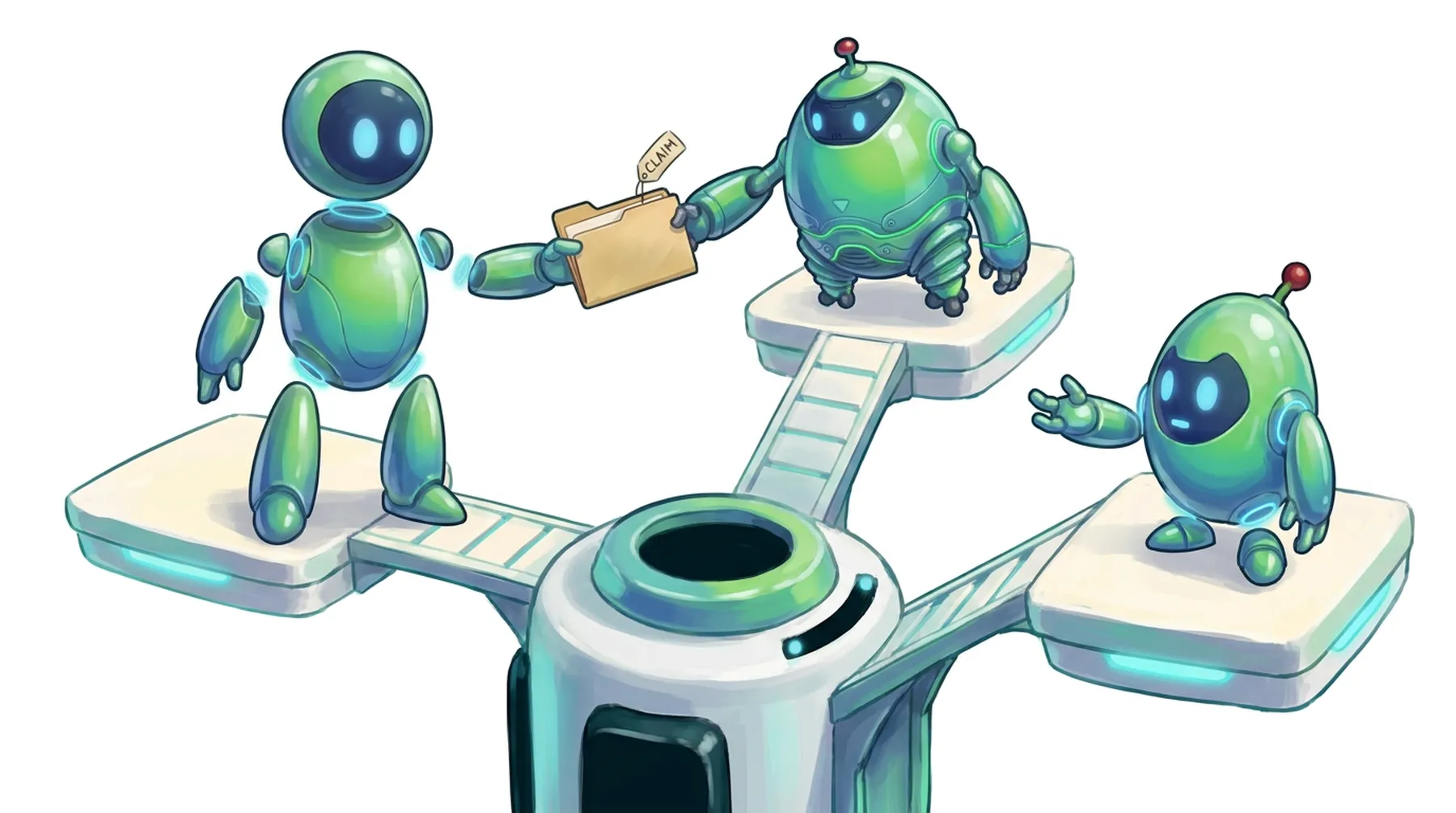
One insurance claim crosses every one of those lines. A LangGraph intake agent opens the claim and passes it to a fraud-review crew on CrewAI. The crew then needs a damage appraisal from an agent run by an independent adjusting firm, outside the insurer's network.
Why AI Agents Struggle to Work Across Different Frameworks
Each framework speaks its own handoff dialect.
LangGraph moves work through its own graph state, while CrewAI has its own task and context model. Those native abstractions do not automatically map onto each other. Without a shared protocol such as A2A, moving the claim between them requires an adapter; with A2A, both sides can expose a common agent-to-agent contract while keeping their internal framework semantics.
The partner boundary adds three problems a translator can't fix:
The adjusting firm's agent expects its own request schema, which matches neither LangGraph state nor CrewAI task output.
The insurer reaches that agent through a URL pasted into config, and the call breaks the day the firm redeploys.
An HTTP 200 confirms the firm's server got the request, and says nothing about whether its agent finished or failed.
Pairwise glue does not scale
Each translator covers one pair. The Agentic AI Foundation describes the pre-standard state the same way: agents on different frameworks "couldn't hand off work to each other without custom integration code written specifically for that pairing" (AAIF, August 17, 2026). With N agents connected pairwise, you maintain up to N(N-1)/2 adapters, which is 45 for ten agents. Enterprise integration teams hit the same curve with point-to-point application links and got off it with a shared contract and a hub-and-spoke broker in the middle.
AI Agent Interoperability Protocols: A2A, MCP, and Beyond
The most useful map of AI agent interoperability standards is still academic. In May 2025, Ehtesham, Singh, Gupta, and Kumar compared MCP, ACP, A2A, and ANP on interaction modes, discovery, communication patterns, and security models, and proposed adopting them in that order.
I read that roadmap as a boundary map, with each step widening the set of agents you deal with. It needs one correction: IBM's ACP merged into A2A in August 2025, so four steps are now three. The survey's comparison dimensions omit routing among many agents, delivery state, and recovery. A2A has since covered part of that ground: the current specification defines task states from submitted to completed or failed, and a client can poll or resubscribe to a task after a dropped connection. It still describes one client talking to one remote agent.
A2A: the agent-to-agent contract
Most of what people mean by A2A protocol AI agent interoperability is peer delegation: an agent publishes an Agent Card describing its skills, and other agents send it tasks without seeing its framework. The wire format and task states are in A2A protocol internals.
MCP: the agent-to-tool contract
MCP is "an open-source standard for connecting AI applications to external systems" (MCP documentation) and has been an Agentic AI Foundation project since December 2025. The intake agent would read the policy database over MCP, while the fraud crew plans on its own and belongs on A2A. Agents versus MCP servers explains the split.
Beyond A2A and MCP
The table sorts the AI agent interoperability protocols in 2026 by the boundary each one covers.
Boundary | Protocol | What it standardizes | Status, November 2026 |
|---|---|---|---|
Agent to tool | MCP | Tool and data access | AAIF project since December 2025 |
Agent to agent | A2A | Agent Cards, task delegation, results | v1.0 since March 2026; absorbed IBM's ACP |
Editor to coding agent | Agent Client Protocol | How an editor drives a coding agent | Unrelated to IBM's ACP |
Open network | ANP | Identity with W3C decentralized identifiers | Last step of the 2025 survey roadmap |
Runtime between agents | None | Routing among many agents, group-wide status, permissions | Left to the implementer |
What changed between 2025 and 2026
Three dated events explain most trends in AI agent interoperability since the survey. A2A v1.0 shipped on March 12, 2026, with signed Agent Cards, version negotiation, and multi-tenancy. On August 17, 2026, A2A joined the Agentic AI Foundation, putting MCP and A2A under one neutral host. The Linux Foundation's April 2026 update still lists an interoperability specification and registry consolidation as A2A roadmap items.
The usual objection is that a stable v1.0 closes the problem. Signed cards settle who an agent is, and negotiation settles which version two agents speak. Neither decides which agent in a multi-agent flow should act on a message, and the specification leaves the meaning of any authorization decision to each agent's implementation.
How to Connect and Coordinate Agents Across Frameworks
Getting MCP and A2A protocol AI agent interoperability right in 2026 is mostly a placement problem: which boundary gets which protocol, and what runs around both. Six steps cover the claim.
Label every boundary the claim crosses as in-framework, cross-framework, or cross-company. Intake to fraud review is cross-framework; the adjuster hop is cross-company.
Keep native handoffs inside a single framework, and add A2A only where the claim crosses a boundary.
Give agents their tools through MCP. Wrapping a peer agent as a tool hides its task state from the caller.
Address agents by a stable name or registry entry instead of an endpoint URL, so the adjusting firm can redeploy without breaking the insurer's calls.
Track delivery state per recipient. "Sent" and "processed" are different facts, and the fraud crew needs to know which one applies to the appraisal.
Pin protocol versions on both sides, and use v1.0 version negotiation when a partner still runs v0.3.
Any team can follow these steps with any vendor. Steps 4 and 5, plus a permission check at each cross-company boundary, describe a runtime layer above the protocols that teams either build or adopt. The A2A scope limits explain why the protocol stops there.
How BAND Enables Cross-Framework Agent Collaboration
Protocols settle the contract between two agents, but the runtime among many agents is still yours to supply, and BAND covers it for the claim. The LangGraph intake agent and the CrewAI fraud crew connect through framework adapters and join one room. Every text message must @mention at least one participant, and only mentioned agents receive it. An unmentioned agent can't read that message later, so the fraud crew never processes chatter meant for someone else, and no model decides the routing.
The adjusting firm keeps its own stack. BAND's A2A adapter connects the firm's agent by URL, so an @mention becomes an A2A request and the reply posts to the room, while the A2A gateway exposes BAND agents as endpoints a partner can call. An outside agent that isn't already a contact needs an approved contact request before anyone can add it to a room. When the appraisal request goes out, the adjuster's copy reports its own status, moving from processing to processed or failed, and BAND records every attempt.
BAND complements A2A and MCP and replaces neither. It never runs your agents' code, so each agent keeps its own framework and model provider, and it is not an LLM evaluation or model drift tool. To try the claim flow on your own agents, start with the BAND A2A integration and the LangGraph adapter, or book a demo.
FAQs about AI agent interoperability
In most cases, yes. The v1.0 Agent Card is backward compatible and can advertise support for both v0.3 and v1.0 at the same time so that clients can migrate in stages instead of through one cutover. Confirm which versions each side's SDK supports first, especially with partners whose upgrade schedule you don't control.
No. IBM merged Agent Communication Protocol into A2A in August 2025, and the BeeAI platform it was built for now uses A2A. The acronym still confuses people, because the Agent Client Protocol, an unrelated standard for connecting code editors to coding agents, also goes by ACP.
Partly. In April 2026, the Linux Foundation reported A2A in production across supply chain, financial services, insurance, and IT operations. An interoperability specification and registry consolidation are still on the roadmap, so AI agent interoperability between two vendors nobody has tested together is something to prove in a pilot first.
Start with identity. A2A v1.0 Signed Agent Cards cryptographically verify an agent's identity and metadata, so you can confirm a partner's agent is the one it claims to be. Identity is not permission, though, so your runtime still needs a per-partner approval step, access scoped to specific agents, and a record of every call.
Sign Up For The Band
A short and to the point summary of what we've been up to, delivered once a month to your inbox.
By submitting this form, I agree to be contacted by Band and receive occasional offers & product updates via phone or email, in line with Band’s Privacy Policy.
Coding agents
Personal AI Agents Explained: Examples, Protocols, and Use Cases
Learn what a personal AI agent is, 10 ways developers use one, which protocol each connection needs, and how to test a first agent-to-agent handoff.
Coding agents
AI Agent Task Delegation: How to Coordinate Multiple Agents
Learn how AI agent task delegation and coordination work, from scoping a subtask to verifying its result, plus the patterns and practices that keep it safe.
Coding agents
AI Agent Routing: The Complete Guide to Building Scalable Multi-Agent Systems
Compare rule-based, semantic, LLM-based, and hybrid AI agent routing, see where tool routing differs, and choose a router your multi-agent system can trust.