Yes. A subagent is a worker agent with its own context window, system prompt, tool access, and permissions. In Claude Code, the main agent hands a side task to a subagent and gets back results instead of the full transcript. That is delegation as a tool call, and the main agent stays accountable for what it does with those results.
AI Agent Task Delegation: How to Coordinate Multiple Agents
Learn how AI agent task delegation and coordination work, from scoping a subtask to verifying its result, plus the patterns and practices that keep it safe.


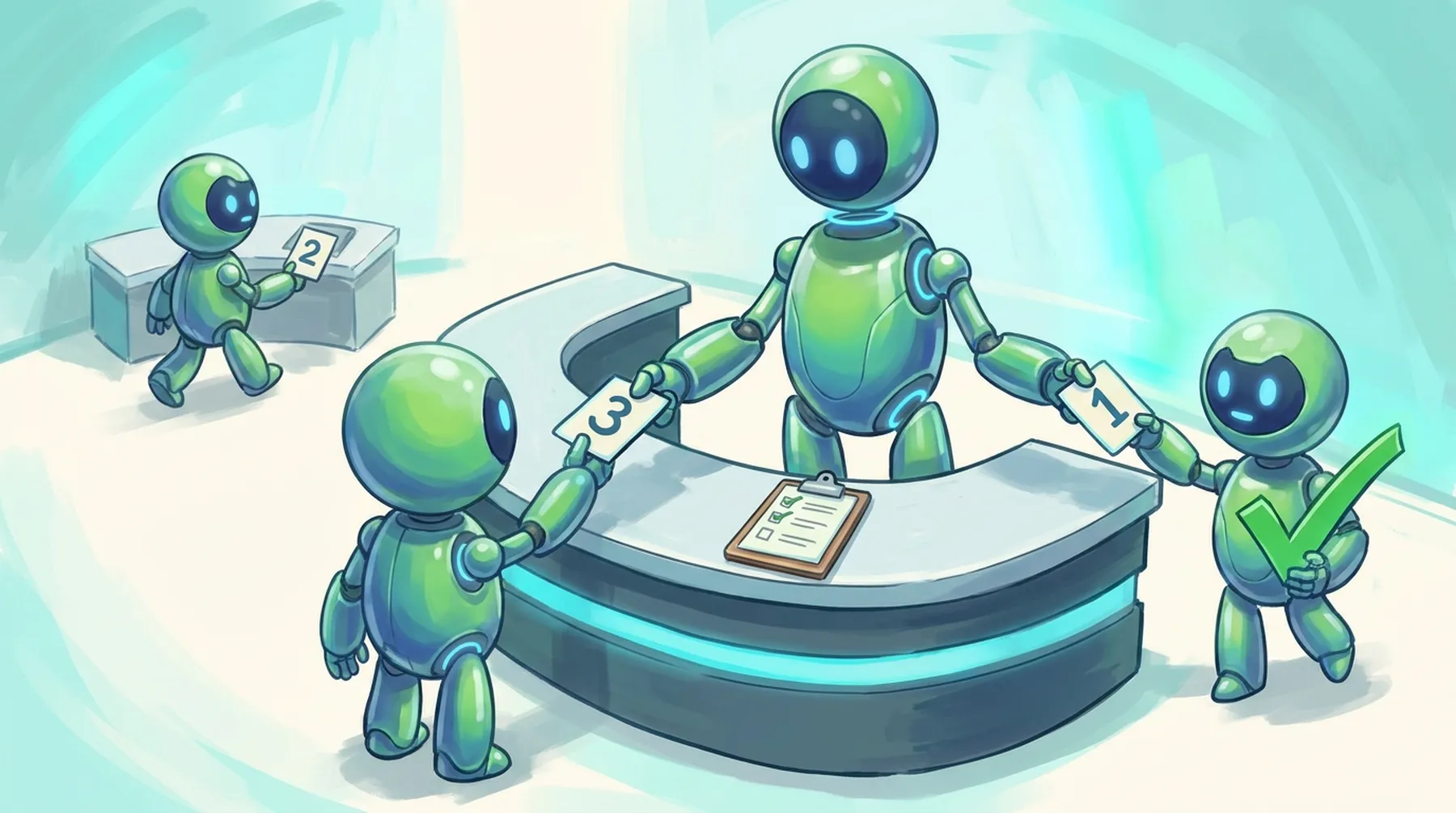
Key takeaways about AI agent task delegation and coordination
AI agent task delegation and coordination means one agent assigns a scoped subtask to another agent and stays accountable for checking the returned result.
Routing decides which agent receives work, a handoff transfers control to another participant, and delegation keeps responsibility for verifying the subtask’s result with the delegating agent.
A delegation contract for each AI agent subtask states the scope, done criterion, deadline, and scoped credentials the receiving agent may use.
A delegating agent accepts a coding subtask as complete only when checkable evidence arrives, such as a passing CI run and a pull request link.
BAND shows each delegated message’s recipient and delivery status, from delivered to processing to processed or failed, across agents running on different frameworks.
How AI Agents Assign, Delegate, and Execute Tasks
An AI agent delegates by splitting its task into subtasks, assigning each to another agent, and holding it open until the result passes a check. In AI agent delegation, the delegator stays accountable from assignment to acceptance. The Intelligent AI Delegation paper (Tomašev, Franklin, and Osindero, 2026) puts it this way: delegation "is more than just task decomposition into manageable sub-units of action," because it assigns responsibility and authority and "thus implicates accountability for outcomes."
The lifecycle of one delegated subtask
Follow one CVE subtask, the patch for billing-api, through five stages:
The platform agent scopes it: bump the shared library in billing-api and touch nothing else.
It assigns the subtask to the coding agent that owns billing-api.
That agent accepts the work or rejects it before starting.
The coding agent patches, builds, and runs the service's tests.
It returns evidence, which the platform agent verifies before closing the subtask.
Three delegation mechanisms
AI agent task delegation mechanisms come in three shapes. A tool call runs the delegatee inside the delegator's turn and returns a value. An addressed message sends the subtask to a named agent that works on its own clock. A task object, such as an A2A task, carries its own states, including REJECTED for an agent that "has decided not to perform the task."
AI Agent Delegation vs. Orchestration vs. Task Routing
The four terms differ by who stays accountable once work leaves the first agent.
Term | Definition | Who stays accountable? |
|---|---|---|
Task routing | Deciding which agent receives a piece of work. A choice at one point in time, with no transfer of accountability. | The router, for the choice only |
Delegation | Assigning a scoped subtask to another agent while the delegator stays accountable and waits for the result. | The delegator, until it accepts the result |
Handoff | Transferring control of the work, and its context, to another agent or a person, after which the sender stops acting on it. | The receiver, from the moment of transfer |
Orchestration | A controller that decides the sequence of steps across agents. | The controller, for the sequence |
AI agent orchestration has its own guide. In the CVE campaign, routing identifies which coding agent should receive each subtask. Still, the larger relationship is delegation: the platform agent assigns fourteen patches and remains responsible for verifying all fourteen.
Common AI Agent Task Delegation and Coordination Patterns
Four AI agent delegation patterns come up again and again, and they differ in who ends up accountable.
Pattern | How the delegatee is chosen | Who stays accountable | How the result returns |
|---|---|---|---|
Manager and workers | The manager assigns by role | The manager | Workers report to the manager |
Contract net bidding | The manager calls for proposals, contractors bid, the manager awards | The manager | The contractor reports completion or cancels |
Fan-out to isolated workers | One worker per piece | The delegator | Each worker returns a summary from its own context |
Chained sub-delegation | Each agent picks the next (A to B to C) | Every link, for everything below it | Results climb back up the chain |
Reid G. Smith described the Contract Net Protocol in 1980, and its bid-and-award shape still fits LLM agents that compete for a subtask.
The chained row carries the paper's sharpest warning. In long chains, each agent risks "acting as an unthinking router rather than a responsible actor," and an "accountability vacuum" opens between intent and execution (sections 2.3 and 5.2). For the CVE campaign that settles a design choice: service agents may not re-delegate, so every chain stays one link long. See multi-agent orchestration patterns for the full catalog and coordination topology costs for what each shape costs.
Managing Task Ownership, Dependencies, and Context Across Multiple Agents
AI agent task delegation coordination across fourteen parallel subtasks rests on three records: an owner, a dependency order, and a context packet.
One owner per subtask
Each subtask gets one owning agent and one accountable delegator, recorded where both can read them. If two agents both think they own search-indexer, you get two pull requests, and neither agent sees the other's.
Ordering subtasks by dependency
The shared library release lands first, because every service imports it. Services that pin it directly go next, then the rest in parallel. Fan out all fourteen at once, and you get fourteen builds failing on the same missing release.
The context packet each agent needs
A delegatee should not be assumed to have the delegator’s full history, so the platform agent passes the context it needs explicitly:
subtask: billing-api/patch-shared-http
advisory: "<CVE ID from the security advisory>."
target_version: shared-http 4.2.1
test_command: make test-integration
rollback: revert the lockfile commit if staging error rate rises
done_when: CI green on the patch branch and a PR opened against main
owner: "@billing/billing-api-agent"
delegator: "@platform/patch-coordinator"
Whatever the packet leaves out, the receiving agent will guess. Session and context identity explains why context so often fails to carry between agent sessions.
AI Agent Task Delegation Frameworks, Tools, and Real-World Use Cases
CrewAI, LangGraph, and the OpenAI Agents SDK each ship a delegation call, and each puts it in a different place.
How frameworks implement delegation
Framework or standard | Where delegation happens | What comes back |
|---|---|---|
CrewAI | allow_delegation=True gives an agent a "Delegate work to coworker" tool with task, context, and coworker arguments (CrewAI collaboration docs) | The coworker's output as the tool result |
LangChain and LangGraph | A supervisor agent calls worker agents wrapped as tools | The worker's final message as the tool result |
OpenAI Agents SDK | "Agents as tools" lets a main agent call a specialist and stay responsible for the final answer | The specialist's output as a tool result |
A2A | A client agent sends a message, and the remote agent returns a task to track the work | States such as WORKING, INPUT_REQUIRED, COMPLETED, FAILED, and REJECTED |
The built-in call works well, and the CrewAI multi-agent orchestration guide walks through one setup. Acceptance, scoped authority, and verification still fall to you. And once the billing-api agent runs on CrewAI in one cluster while search-indexer runs on LangGraph in another, the platform agent can no longer see whether each subtask was received or who holds it.
Where delegation earns its keep
A fleet-wide security patch is the clearest case: real dependencies, fourteen ownership boundaries, and a done criterion CI can check. Dependency upgrade campaigns have the same shape at lower urgency. Flaky-test triage fits too, with one failing test per agent and either a fix or a quarantine note coming back.
Best Practices for Coordinating AI Agent Tasks in Software Development
These six practices cover delegation only. General habits live in agentic coding best practices.
Write a delegation contract per subtask: scope, done criterion, authority, and deadline. The paper wants task granularity "tailored a priori to match available verification capabilities," so you only delegate what you can check.
Grant scoped, expiring credentials per subtask. Handing raw API keys or open MCP sessions to sub-agents "would violate the principle of least privilege," per the paper. Here that means write access to one repository for one day.
For this patch campaign, count a passing CI run plus a pull request link as completion. A coding agent can report success while its build is red.
Track acceptance separately from completion, so a subtask that was never picked up becomes visible before its deadline.
Escalate to a person above a blast-radius threshold, such as any change to the authentication gateway. See approval gates under delegation.
When a delegatee fails the same subtask twice, consider re-scoping it before retrying with the same context again.
If only one practice survives, make it verification: it is the one that tells you whether the patch actually shipped.
How BAND Keeps Delegated Work Visible Across Agents
Delegation holds up when the delegator can see, for every subtask, which agent received it, whether work started, and what evidence came back. When fourteen subtasks go to agents built by different teams on different frameworks, the platform agent needs that view across all of them. For each subtask, BAND keeps the receiving agent's delivery status (delivered, processing, processed, or failed) and numbers each attempt. If the search-indexer agent crashes mid-patch, its subtask stays in processing instead of disappearing.
BAND does not decompose the campaign, pick delegatees, or judge whether a patch is correct. Those calls, and the accountability, stay with the delegator. Framework adapters and an outbound A2A adapter reduce the custom integration needed to send delegated work across framework boundaries. Qodo built Qodo's Dark Factory on BAND so agents "running in different clusters and under different credentials can operate as one team."
See multi-agent lifecycle rooms and coordinating coding agents for the room model, or book a demo with your own delegation flow.
FAQs about AI agent task delegation and coordination
Skip delegation when writing the context packet would take longer than doing the work, when the context cannot fit in a message without losing something, or when the authority the task needs cannot be scoped down. A two-line config change in a file the delegating agent already has open is faster to make in place.
Autonomous delegation means the agent splits the task and picks delegatees without asking a person first. How much is safe depends on whether the action can be undone. The Intelligent AI Delegation paper borrows M. C. Elish's term "moral crumple zone" to warn against delegation chains where people sit only to absorb liability. Give agents more latitude for low-risk, reversible work, and require stronger approval for actions with high or irreversible impact.
Give delegation rights to coordinators only. CrewAI's troubleshooting docs fix delegation loops by setting allow_delegation=False on specialist agents. Cap delegation depth as well. Claude Code, for comparison, stops subagent nesting at three layers by default.
The delegator decomposes until each subtask has one owner and a result it can check. A delegatee may split its piece further, but at that point it becomes a delegator for those pieces. The Intelligent AI Delegation paper treats responsibility as transitive: agents "cannot absolve themselves of accountability by blaming subcontractors."
Sign Up For The Band
A short and to the point summary of what we've been up to, delivered once a month to your inbox.
By submitting this form, I agree to be contacted by Band and receive occasional offers & product updates via phone or email, in line with Band’s Privacy Policy.
Coding agents
Personal AI Agents Explained: Examples, Protocols, and Use Cases
Learn what a personal AI agent is, 10 ways developers use one, which protocol each connection needs, and how to test a first agent-to-agent handoff.
Coding agents
AI Agent Interoperability: Connecting Agents Across Frameworks
Why agents built on different frameworks cannot talk by default, what A2A and MCP standardize in 2026, and the runtime layer teams still have to add.
Coding agents
AI Agent Routing: The Complete Guide to Building Scalable Multi-Agent Systems
Compare rule-based, semantic, LLM-based, and hybrid AI agent routing, see where tool routing differs, and choose a router your multi-agent system can trust.