An LLM router picks which model answers a prompt, trading a cheaper model against a stronger one. RouteLLM reports cutting costs by more than 2x in some cases without losing quality. AI agent routing picks which agent owns the work. One system can use both.
AI Agent Routing: The Complete Guide to Building Scalable Multi-Agent Systems
Compare rule-based, semantic, LLM-based, and hybrid AI agent routing, see where tool routing differs, and choose a router your multi-agent system can trust.



Key takeaways about AI agent routing
AI agent routing decides which agent receives a request at one point in time; it does not by itself define who remains responsible for the finished work.
Rule-based routing handles fixed intents like password resets without a model call, and hybrid routing escalates only ambiguous requests, like outage reports, to an LLM.
Agent routing picks which agent owns a request, while AI agent tool routing picks which function one agent calls inside its own turn.
Before an AI agent router goes live, the router needs a fallback target, a confidence threshold, and a log entry for every routing decision.
BAND delivers each routed message only to the agents named by @mention and records processing, processed, or failed status for each recipient agent.
What Is AI Agent Routing and How Does It Work?
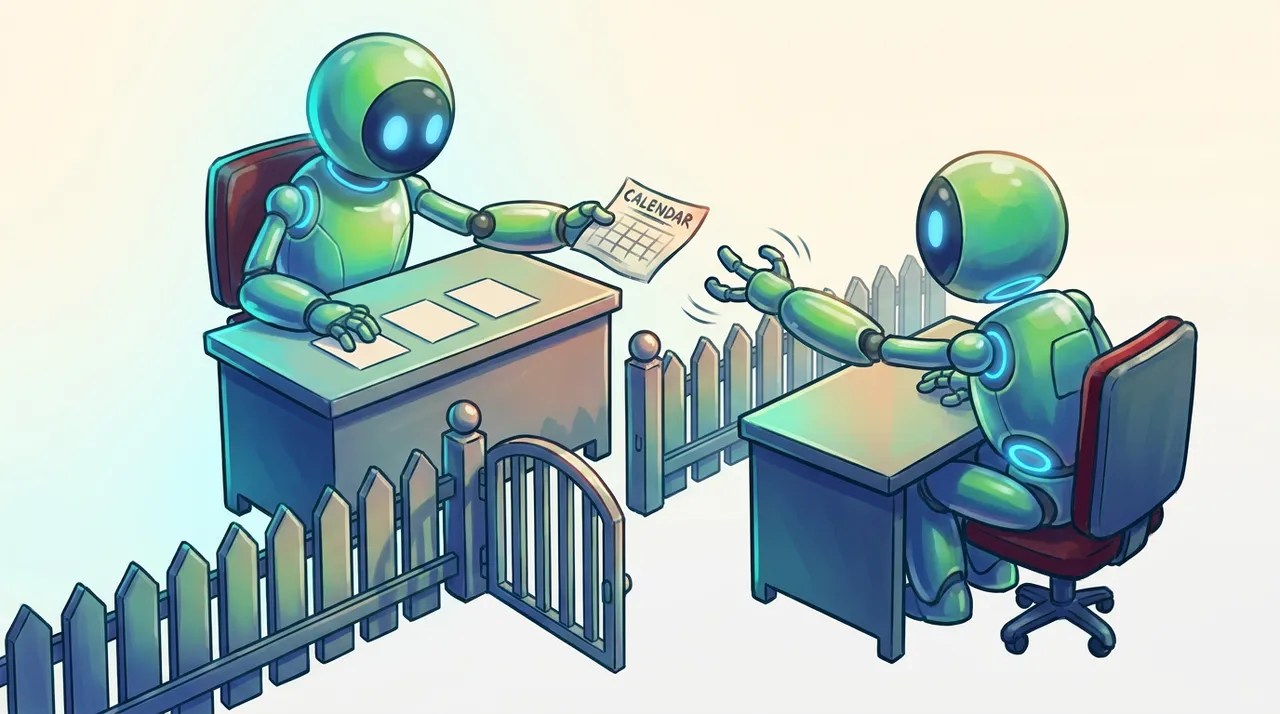
Routing means deciding which agent receives a piece of work at a given time. It does not by itself define ownership or accountability. In delegation, the delegator stays accountable and waits for the result. In a handoff, control and context move to the receiver, and the sender stops. A router is one component inside wider AI agent orchestration.
What a router does with each request
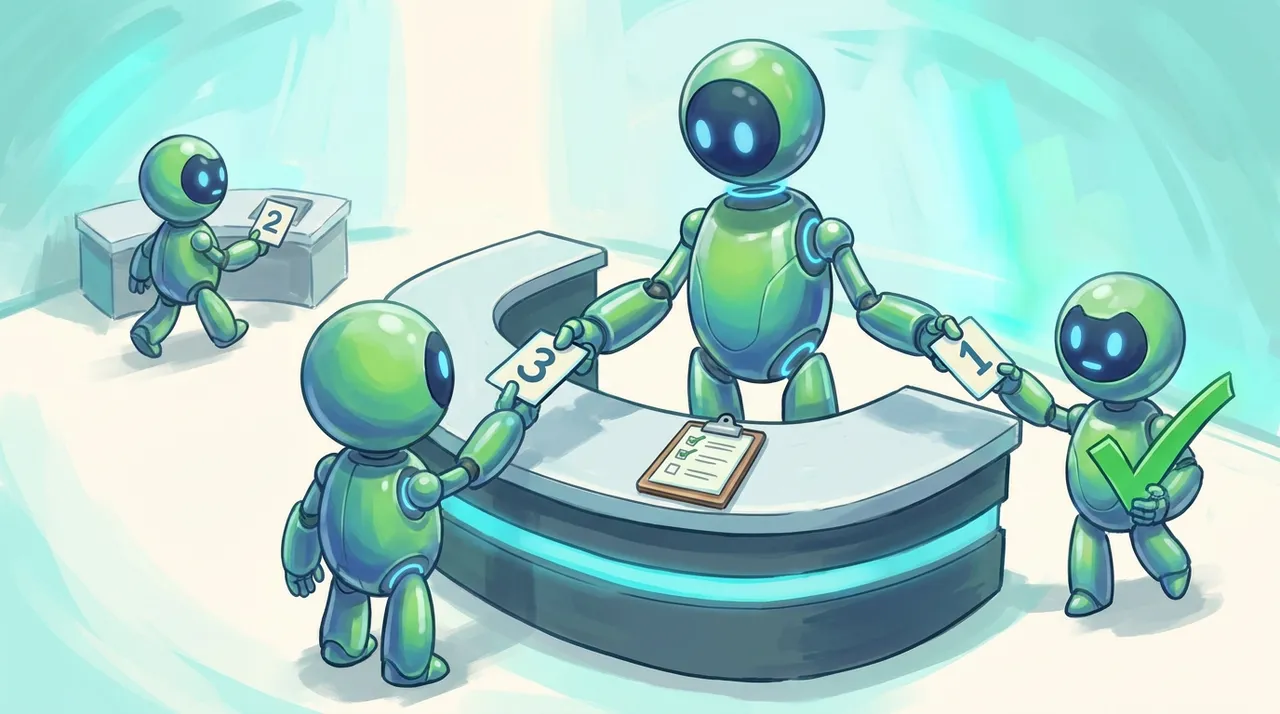
A ticket says "I can't get into Workday after the password change." The router classifies it as a password problem, selects the identity agent, and dispatches the ticket with a record of the decision. Skip the record, and you will want it the first time a ticket sits in the wrong queue for two hours.
Agent routing vs. tool routing
Agent routing picks which agent owns the ticket. AI agent tool routing happens later, inside that agent's turn, when the identity agent chooses between reset_password and unlock_account. Model routing, which picks the LLM tier, is a third decision.
AI Agent Routing Approaches: Rule-Based, Semantic, LLM-Based, and Hybrid
Four approaches cover most routers. They differ in how much they must understand the input, so pick one per input class instead of one for the whole system.
Approach | How it decides | Holds for | Breaks when | Help-desk example |
|---|---|---|---|---|
Rule-based | Form field, keyword, or exact intent | Fixed intents | New phrasing falls through to a default | Reset-form tickets to the identity agent |
Semantic | Embedding match against agent descriptions | Varied wording, same meaning | Agent descriptions overlap | "Edit rights on the finance share" to the access agent |
LLM-based | A model returns the target, often as a function call | Messy, multi-symptom input | Each request pays for a model call; wrong answers sound sure | "VPN drops and Okta keeps looping" |
Hybrid | Rules, then a classifier, then an LLM | Mixed traffic | More stages to test and log | Resets skip the model; outages reach it |
In a position paper on hybrid AI routers, Yao and colleagues describe an intent router that can run on function calling: the model returns the agent name plus arguments such as a confidence level, and small function-calling models keep latency low without fine-tuning. A better prompt helps an LLM router on messy tickets, yet the reset form still pays for a model call it never needed.
A fifth option skips inference: the sender names the receiver with an @mention. That is deterministic but works only when the sender knows who should act.
AI Agent Routing Architectures and Design Patterns
An AI agent routing architecture diagram usually shows one of four shapes, separated by how often the router decides and how many agents one request reaches.
Single dispatch sends a request to one agent, as with most password resets.
Parallel fan-out sends one request to several agents at once, such as a new-hire ticket that needs an account and group memberships.
Hierarchical routing has a top router pick the domain (e.g., IT or HR), and a domain router pick the agent.
A run-once router decides at intake, while a supervisor decides every turn and keeps the context.
A supervisor calls a model on every turn, so that last choice moves your model bill the most. The wider catalog lives in multi-agent orchestration patterns.
Best AI Agent Routing Frameworks and Tools
Most frameworks ship a routing primitive. They differ in who makes the call.
Framework or tool | Who decides | Worth knowing |
|---|---|---|
LangGraph router | Often one LLM call or rule logic | LangChain's router docs use Command for one agent and Send for fan-out |
AutoGen SelectorGroupChat | A model reading agent descriptions and history | A custom selector_func overrides the model |
CrewAI hierarchical process | A manager agent | Assigns tasks by agent capability and reviews output |
OpenAI Agents SDK | The running agent | Handoffs appear to the model as tools |
RouteLLM | A trained router | Picks a stronger or weaker LLM per prompt (model routing) |
Each one routes inside its own runtime. LangGraph's Command and Send target nodes in the same graph, so reaching another team's CrewAI crew takes a protocol call such as A2A, which both frameworks support. The call goes through, and each runtime logs its own half. See multi-agent orchestration frameworks for the runtimes.
How to Build and Implement an AI Agent Routing System
Build in this order. The fallback comes early because it decides what happens when the classifier is wrong.
Write a routing card per agent. The AgentSkill object in the A2A specification makes a usable template: id, name, description, tags, and example requests.
Choose an approach per input class: rules for resets, semantic matching for access requests, an LLM for outage reports.
Name the fallback before adding agents. Unclassified tickets go to the human service-desk queue, never to the top-scoring agent.
Set a confidence threshold. Below it, the router asks one clarifying question or falls back. Start strict and relax it as the logs earn trust.
Log the input, target, approach, and confidence for every decision. Without that log, a misroute looks like a slow agent.
AI Agent Routing Use Cases: From Enterprise Automation to Autonomous Software Development
A hybrid router earns its extra stages on tickets like "VPN drops and Okta keeps looping." No rule matches. Semantic matching scores the incident triage agent and the identity agent almost level, below the threshold, so the LLM tier reads the ticket, finds two problems, and fans it out to both. A single-target router would have fixed half of it.
Software development routes by role instead: a planner, a coder, and a reviewer each get the part of a change that matches their card. Agentic coding workflows cover that sequence.
AI Agent Routing Challenges, Best Practices, and Performance Optimization
Four failures recur, each with a fix you can ship before traffic grows.
Silent misroutes. The wrong agent answers with confidence, and nobody notices until the ticket reopens. Log decisions and let agents return work as not theirs.
Latency and cost. An LLM call in front of every ticket delays all of them. Put rules first and consider a smaller function-calling model for straightforward routing decisions.
Routing loops. Two agents keep passing a ticket back and forth. Set a hop limit that sends it to the human queue.
Growing candidate lists. Each new agent lengthens the selection prompt, so pre-filter candidates or route hierarchically.
Those fixes assume a layer under the router: delivery to the chosen agent only, a stable name, and a pickup record people can read. One framework's runtime provides that for its own agents. Across frameworks, A2A carries each call and its task state between two endpoints. Still, a shared record of every route is yours to build, a gap covered under hard production problems and multi-agent observability.
How BAND Works as an AI Agent Routing Chat Platform
A year later, the identity agent runs on LangGraph, the access agent on CrewAI, and the incident triage agent comes from a vendor over A2A. Your router still picks correctly. What you lose is one place that shows who received each ticket and whether it was processed. That shared record is the job of an AI agent routing chat platform, and BAND connects all three agents through its LangGraph and CrewAI adapters and its A2A adapter.
In a BAND room, every text message names its recipients by @mention, and routing is deterministic: no model decides who receives it. Unmentioned agents never see the ticket, while everyone else sees every message. Each agent keeps a handle like @username/agent-handle wherever it runs, so the router targets a name instead of an endpoint. The receiver marks the message as processed or failed, and a crashed agent gets the ticket back on restart.
BAND does not choose the target. Your router makes that call, and BAND delivers it and keeps the record. If you can't prove where your tickets went, see the BAND agentic mesh and BAND platform, or book a demo.
FAQs about AI agent routing
No. Contact-center routing assigns customer conversations to human agents by skill and availability. AI agent routing assigns work to software agents by declared capability. A misrouted call usually reaches a person who transfers it. A misrouted software request can come back as a confident wrong answer.
No fixed number exists, but larger candidate sets can make accurate selection harder. In the RAG-MCP study, retrieving relevant candidates first raised tool selection accuracy from 13.62% to 43.13%. It measured tools rather than agents, but the fix carries over: pre-filter or route hierarchically.
Yes. The A2A protocol defines a terminal rejected state for a task an agent decides not to perform. Treat a rejection as a cue to reroute or fall back, since resending the ticket to the same agent will likely get the same answer.
Replay labeled history. Run last quarter's tickets, tagged with the queue that resolved each one, through the router, and count misroutes per agent. Misroutes clustered on one agent point to a vague routing card. Rerun the set whenever an agent's description changes.
Sign Up For The Band
A short and to the point summary of what we've been up to, delivered once a month to your inbox.
By submitting this form, I agree to be contacted by Band and receive occasional offers & product updates via phone or email, in line with Band’s Privacy Policy.
Coding agents
Personal AI Agents Explained: Examples, Protocols, and Use Cases
Learn what a personal AI agent is, 10 ways developers use one, which protocol each connection needs, and how to test a first agent-to-agent handoff.

Coding agents
AI Agent Interoperability: Connecting Agents Across Frameworks
Why agents built on different frameworks cannot talk by default, what A2A and MCP standardize in 2026, and the runtime layer teams still have to add.
Coding agents
AI Agent Task Delegation: How to Coordinate Multiple Agents
Learn how AI agent task delegation and coordination work, from scoping a subtask to verifying its result, plus the patterns and practices that keep it safe.